
Currently Empty: $0.00
About Course
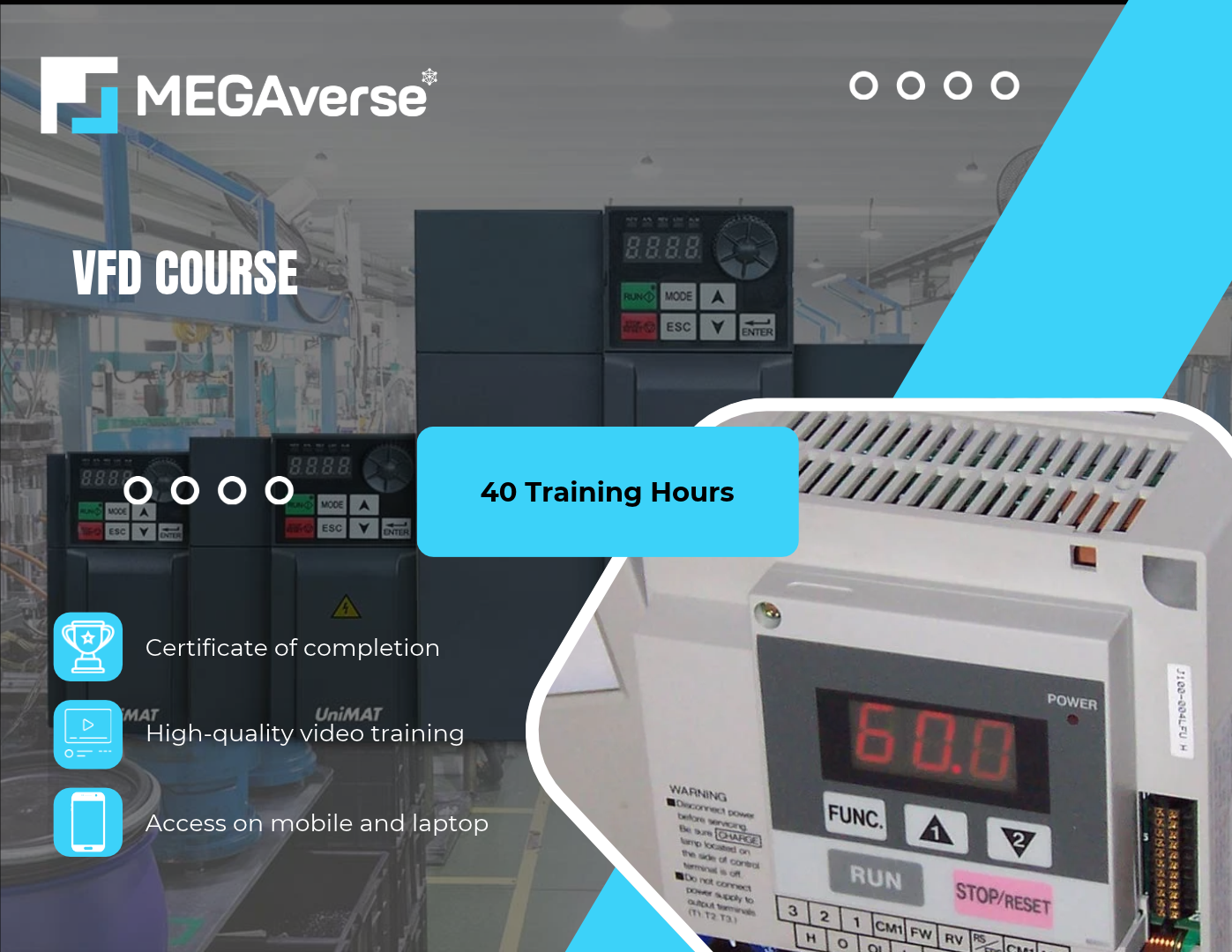
The VFD (Variable Frequency Drive) Course is designed to provide learners with the theoretical knowledge and practical skills required to understand, install, configure, program, and troubleshoot variable frequency drives used in industrial motor control applications.
The course starts with the fundamentals of VFDs and electric motors, covering the internal components of a drive, motor and drive nameplate interpretation, technical manuals, drive selection, installation requirements, and essential operating precautions.
It then focuses on practical VFD operation and programming, including motor parameter configuration, drive programming menus, fixed and variable speed control, analog signal control, potentiometer connections, proximity sensor integration, multifunction digital inputs, stopping methods, DC braking, and drive protection functions.
In addition, the course covers the integration of VFDs with Programmable Logic Controllers (PLCs) using both conventional hardwired control and industrial communication protocols. Learners will explore MODBUS communication over RS485, communication card installation and configuration, and practical applications involving PLC-based control of one or multiple VFDs.
Through a combination of theoretical explanations and practical demonstrations, participants will develop the skills needed to work with VFDs in industrial environments and understand how drives, sensors, and PLCs work together in automated systems.
Course Content
Lectures
-
Lecture 1
00:00 -
Lecture 2
00:00 -
Lecture 3
00:00 -
Lecture 4
00:00 -
Lecture 5
00:00 -
Lecture 6
00:00 -
Lecture 7
00:00 -
Lecture 8
00:00 -
Lecture 9
00:00 -
Lecture 10
00:00 -
Lecture 11
00:00 -
Lecture 12
00:00 -
Lecture 13
00:00 -
Lecture 14
00:00 -
Lecture 15
00:00 -
Lecture 16
00:00 -
Lecture 17
00:00 -
Lecture 18
00:00 -
Lecture 19
00:00 -
Lecture 20
00:00 -
Lecture 21
00:00 -
Lecture 22
00:00 -
Lecture 23
00:00 -
Lecture 24
00:00 -
Lecture 25
00:00 -
Lecture 26
00:00 -
Lecture 27
00:00 -
Lecture 28
00:00 -
Lecture 29
00:00 -
Lecture 30
00:00 -
Lecture 31
00:00 -
Lecture 32
00:00 -
Lecture 33
00:00 -
Lecture 34
00:00 -
Lecture 35
00:00 -
Lecture 36
00:00 -
Lecture 37
00:00 -
Lecture 38
00:00 -
Lecture 39
00:00 -
Lecture 40
00:00 -
Lecture 41
00:00 -
Lecture 42
00:00 -
Lecture 43
00:00 -
Lecture 44
00:00 -
Lecture 45
00:00 -
Lecture 46
00:00 -
Lecture 47
00:00 -
Lecture 48
00:00 -
Lecture 49
00:00
Student Ratings & Reviews

No Review Yet


